A man walks into a clinic with a headache he’s had for three weeks. He has ten minutes with the doctor.
The doctor asks what brings him in, and he says, “I don’t know, I just feel off.” He leaves with paracetamol and a note to rest.
Two rooms over, a woman with the same headache says it started after a fall, gets worse when she lies down, and has begun to blur her vision. She leaves with a scan booked for the morning.
The same symptom takes two different paths, and the difference lies in the words each patient chooses.
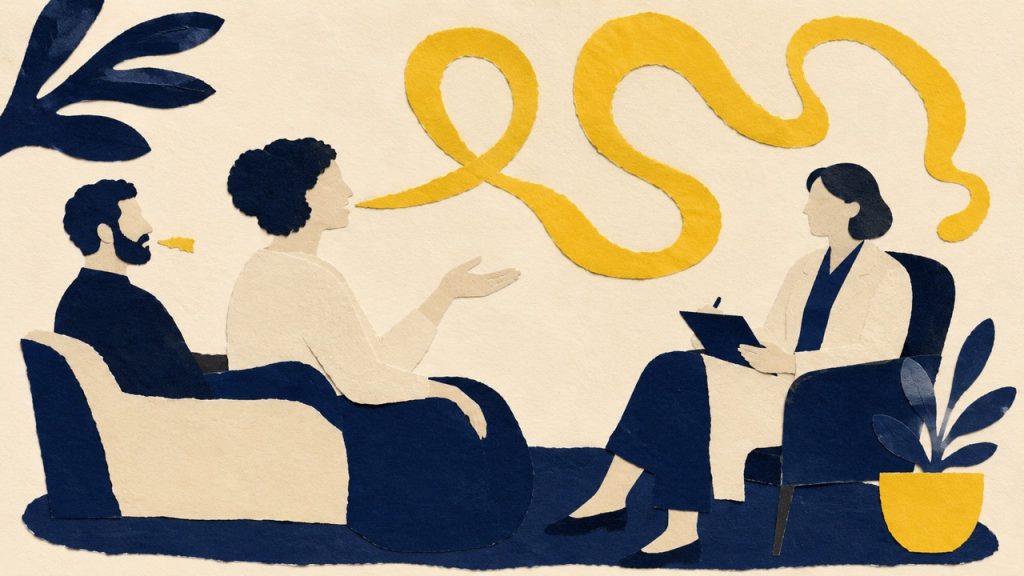
There’s a wide blind spot in modern medicine where the whole process runs on the patient talking to the clinician.
Your body doesn’t speak English, so you have to turn sensation into sentences, and you have to do that while you feel unwell.
The details that count aren’t just how you feel. There’s onset, duration, and how the thing has changed over the weeks. These are crucial narrative details that steer what happens next.
The words do most of the work
In a classic 1975 study of medical outpatients, physicians reached the finally accepted diagnosis from the patient’s history alone in 66 of 80 new cases, before any physical exam or lab test.
The physical examination helped in only seven more, and laboratory tests in another seven.
Teams have repeated the test across the four decades since, in different countries and specialties, and the history keeps producing most of the answer.
| Decade | Study | Setting | Diagnosis from history alone |
| 1990s | Peterson et al., US (1992) | Medical outpatients | 61 of 80 patients |
| 2000s | Roshan & Rao, India (2000) | General medicine | 77 of 98 patients |
| 2010s | Wang et al., US (2018) | Neuro-ophthalmology | 88% of cases |
| 2020s | AI test, 30 BMJ cases (2024) | Case vignettes | 23 of 30 cases |
There’s only a small window to say it
There’s a short window for articulating your problem at the doctor’s office.
In a 2018 analysis of recorded consultations, clinicians invited the patient to set the agenda in only 36% of visits.
When they did, they interrupted after a median of 11 seconds. Patients who were left to finish took a median of 6 seconds to state their concern.
You get one short run to be clear before the conversation narrows to yes-or-no questions. The stakes ride on those seconds.
A 2015 national review of diagnosis in the United States concluded that most people will face at least one diagnostic error in their lifetime.
Around 5% of adults who seek outpatient care each year experience one, and diagnostic errors contribute to roughly 10% of patient deaths.
A clear description doesn’t guarantee the right answer, but it feeds the part of the process that produces most of them.
There’s also a question of who the system serves well. The first national measure of health literacy in the US (conducted in 2003, published in 2006) found that only 12% of adults could handle complex health tasks, such as reading a dense leaflet or working out a dose from a table (‘proficient health literacy’).
School lessons in writing and speaking tend to point at essays and stories. But I think the same training covers something more practical: noticing what’s happening to you (or inside you) and reporting it to someone who can act on it.

How to prepare to speak at the doctor’s room
You can prepare for that room the way you’d prepare for any short, high-pressure talk.
- Track the symptom before you arrive: when it began, what makes it better or worse, how it’s moved over time.
- Lead with your main concern in one plain sentence, then add the timeline.
- Bring numbers where you have them, a temperature, a count of days, a pain rating from one to ten.
- Say what you fear it might be, so the clinician hears your reasoning and not only your symptom.
| Vague | Clear |
| “I feel off.” | “I’ve had a dull headache for three weeks.” |
| “It’s been a while.” | “It started on the 1st and hasn’t stopped.” |
| “It comes and goes.” | “It’s worse each morning and eases by noon.” |
| “I’m tired a lot.” | “I sleep eight hours and still nap by 2pm.” |
None of this asks for medical training. It just asks for observation and plain reporting—the same skills that carry a person through a speech or conversation.