TLDR: The speakers who command the biggest fees aren’t necessarily the most polished performers in the room. They’re the ones who can point to a clear, documented shift they’ve produced in previous audiences. That’s the thing you’re selling.
Speaking is a side effect of expertise
Aspiring speakers tend to lead with the speaking:
- They build a speaker website before they’ve built a body of work.
- They pitch conference organisers before they’ve established a point of view.
- They list speaking topics they’re comfortable discussing rather than problems they’ve spent years solving.
And then they’re confused when nobody bites.
I made the same mistake when I was starting out. I thought, “I’m pretty good at speaking. I want to get on stage and get paid for this.”
Cue crickets. 🦗
The right order is expertise first, platform second.
Your speaking career should be a natural extension of something you already know how to do, something you’ve done enough times to have opinions, stories, data, and a clear perspective on.
Maybe that’s diversity and inclusion work inside higher education institutions. Maybe that’s building an ethical AI workflow inside a content business. Maybe that’s navigating a non-linear career across four industries and two continents.
Whatever it is, the thing you speak about should feel slightly redundant to you, because you’ve been living inside it for years.
When that’s true, the speaking becomes almost incidental. Organisers aren’t booking you to fill a slot, but because you’ve solved the exact problem their audience is wrestling with, and they need you to compress your experience into a session their people can act on.
What this means in practice
Don’t try to pick a “speaking topic.” Pick the problem you’ve spent years inside.
Then ask yourself: what does an organisation look like before they’ve heard what I have to say, and what does it look like after?
If you can answer that clearly, you have a transformation. If you can’t, you merely have a topic. And topics don’t get booked at the fees you’re aiming for.
Avoid saying “I speak about leadership” or “I do talks on personal branding.” Those are topics, not transformations.
A transformation sounds more like this: “I help mid-career professionals stop waiting for a promotion and start building authority on their own terms.”
Or: “I help leadership teams move from diversity as a compliance exercise to inclusion as an operational advantage.”
That sentence should describe a before and an after. It should name who the audience is, what they currently believe or do, and what they’ll believe or do differently once you’ve done your job.
Once you’ve defined that transformation, your content strategy writes itself:
- You put out posts, articles, and videos around that specific territory.
- You go on podcasts that reach the people who book speakers in your space.
- You get in touch with programme directors and event organisers who run conferences where your audience shows up.
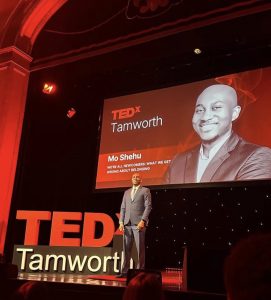
- You let your TEDx talk do what it was designed to do, which is to serve as public evidence that you can hold a room and shift how people think.
| Stage | Leads-with-speaking approach | Leads-with-expertise approach |
| Positioning | “I’m a speaker on leadership” | “I help boards govern through uncertainty” |
| Content | Generic speaking tips | Deep-dive insight into your specific domain |
| Outreach | Cold pitches to event bookers | Warm inbound from people who’ve read your work |
| Fee conversation | Negotiating on delivery quality | Negotiating on the value of the transformation |
| Long-term growth | Dependent on performance | Compounds with reputation and published thinking |
What this means for your speaking fees
There’s a direct relationship between the clarity of your transformation and the size of your fee.
Vague speakers get vague budgets. Specific speakers, with a defined audience, a documented outcome, and evidence that they’ve produced that outcome before, command specific investment.
When you can walk into a fee conversation and say, “Here’s what your audience is currently experiencing, here’s the shift I’ll produce, and here’s what that’s looked like in other rooms,” you’re no longer negotiating on the basis of how good a speaker you are.
You’re negotiating on the basis of how much that shift is worth to their business or community.
That’s a completely different conversation. And it’s a much more profitable one.

Three-time TEDx speaker, broadcast presenter, and founder of The Mo Talk Show. Mo trains individuals and teams to speak with greater clarity, confidence, and impact—and writes about public speaking, performance anxiety, and communication.