Every week, thousands of new podcasts go live. Most of them are gone within a month because they make a cluster of avoidable mistakes right at the start.
If you’re about to launch your podcast, or you’ve just published your first few episodes, these are the seven most damaging mistakes new podcasters make at launch, and what you should do instead.
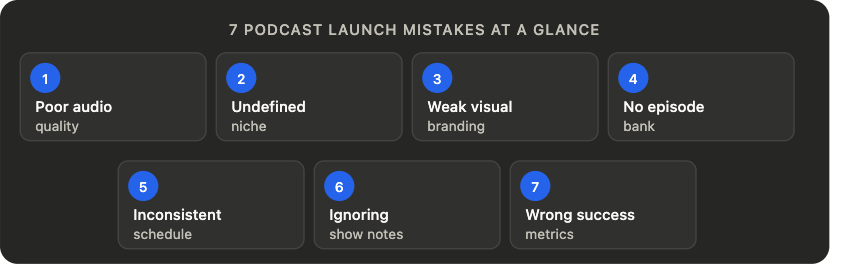
1. Launching with poor audio quality
Listeners will forgive an imperfect idea, but they won’t forgive bad audio. Excessive background noise, echo, inconsistent volume, or a tinny or muffled microphone each signal to a first-time listener that you haven’t taken your own show seriously enough. If you haven’t, why should they?
The good news is that professional-grade audio doesn’t require a professional studio. A decent USB microphone (the Shure MV7, Audio-Technica ATR2100x, and Rode NT-USB Mini are popular choices under $200), a quiet room, and some soft furnishings to absorb echo will put you ahead of most podcasts in your category. If you want a no-cost recording hack, try a wardrobe full of clothes. It works remarkably well.
Put headphones on and listen back to a test recording with your eyes closed before you launch. If anything about the sound pulls your attention away from the words, fix it first.
The rule: Solve audio before everything else. It’s the one mistake you can’t recover from after launch.
2. Starting without a clearly defined niche
Broad topics attract no one in particular. Specific ones attract a devoted audience who feel like you made the show just for them.
“Business” is a topic. “The lessons first-generation entrepreneurs learn in their first year of running a product business” is a niche. The second sounds smaller, but it speaks directly to a specific listener who immediately thinks: this show gets me.
Answer two questions precisely before you record anything: who’s your listener, and what specific problem or interest does your show serve for them? More importantly, would they feel compelled to share it with others just like the?
Vague answers produce vague content, and vague content doesn’t build loyal audiences.
The rule: The narrower your niche, the more clearly it speaks to the right people. Specificity is a growth strategy, not a limitation.
3. Underestimating cover art and visual branding
Your cover art is the first thing a potential listener sees. On a crowded podcast platform, weak visual branding works against you before anyone hears a single word of your audio.
Cluttered text, low-resolution images, or a design that looks disconnected from any broader brand identity each signal a lack of investment in the show. They create a first impression that even excellent content will struggle to overcome. And unlike audio quality, which a listener discovers after clicking play, bad cover art stops them from clicking at all.
Use a professional design tool like Canva or commission a designer. Use readable typography at thumbnail size, a consistent colour palette, and a visual style that matches the tone of your show. If your podcast connects to a broader brand, make sure the cover art connects to it too.
The rule: Your cover art is your podcast’s shopfront. If it doesn’t make someone pause in a feed, they’ll keep scrolling without ever hearing your voice.
4. Publishing without an episode bank
Many new podcasters launch with one or two episodes and plan to record the rest as they go. That creates immediate pressure, and pressure is the enemy of consistent quality. When life intervenes—a busy week, an illness, a delayed guest—the schedule slips, confidence drops, and the whole thing stalls.
Three to five recorded episodes before your launch date removes that pressure entirely. It gives you a buffer, time to improve your editing workflow, and the freedom to respond to early listener feedback without scrambling. It also means your published episodes will benefit from the practice reps you build across recording sessions three, four, and five.
Launch with a minimum of three episodes live on day one. One episode isn’t enough to convert a curious visitor into a subscriber.
The rule: Three episodes live on day one plus a two-episode reserve is the minimum viable launch stack. Never go live without a buffer.
5. Publishing without a consistent schedule
This mistake ends more podcasts than any other. A show launches with energy, the first few episodes arrive on time, and then one is late, then another, then a month passes. Your nascent audience drifts away.
A podcast builds trust through consistency. When listeners know a new episode arrives every Tuesday morning, they build a listening habit around it, which is valuable to your podcast.
Pick a cadence you can sustain for two years, not two months. One well-produced weekly episode beats two rushed ones that leave you burned out within a month. Batch-record whenever you can so you always have a buffer, and treat your publishing deadline as a professional commitment.
The rule: Sustainable consistency beats impressive frequency. Pick the schedule you can keep, not the one that sounds best.
6. Treating show notes as an afterthought
Show notes are how your podcast becomes discoverable through search. Every episode you publish is a potential entry point for a new listener who typed a relevant question into Google.
Without detailed, keyword-aware show notes, your podcast relies entirely on platform algorithms and word of mouth to reach new ears.
Good show notes don’t need to be long. They need a clear summary of what the episode covers, the key takeaways, and timestamps for major topics. Write them as if someone who hasn’t listened yet will read them first, because many people will.
Without them, each episode stops working for you the day after it’s published. With them, it keeps working for years.
The rule: Show notes aren’t a publishing formality. They’re your most powerful long-term discoverability tool. Write them with the same care you give the episode itself.
7. Measuring early numbers against the wrong benchmarks
Most new podcasts attract fewer than 100 downloads per episode in their first month. That’s a completely normal starting point, and the podcasters who build large audiences are almost universally the ones who kept going past the point of discouragement.
Measure the right things early on: are your episodes improving? Are a small number of listeners responding with genuine enthusiasm? Are you learning what your audience wants to hear? Those signals matter far more than raw download counts at this stage.
Commit to 21 episodes before you make any serious assessment of whether the show is working. That’s roughly where most podcasters find their voice, build a small loyal base, and start to understand what the show can actually become. It’s also the point by which about 90%+ of your competitors will have stopped recording.
The rule: Early download numbers measure awareness, not quality or potential. Judge your show by improvement and engagement, not by a number that hasn’t had time to grow.
What all seven podcast launch mistakes have in common
Every mistake on this list comes down to the same thing: impatience. Impatience to launch before the audio’s ready, impatience to skip the episode bank, impatience to judge results before the show’s had time to find its footing, flair, and future funding.
The podcasters who build durable, growing shows treat the launch as a starting block, not a finish line. They invest in the right foundations, commit to consistency over perfection, and give their shows the time they need to compound.
Give your audience the respect of a show that takes itself seriously enough to commit.
Quick reference table: 7 podcast launch mistakes
| # | Mistake | Why it kills momentum | Quick fix |
| 1 | Poor audio quality | Listeners stop within seconds, often before hearing your best content | USB mic, quiet room, headphone quality check before launch |
| 2 | Undefined niche | Broad shows speak to no one in particular | Define your listener and their specific need before recording episode one |
| 3 | Weak cover art | Prevents clicks before a single word of audio is heard | Commission a designer or build a bold, readable cover in Canva |
| 4 | No episode bank | One missed week breaks the early habit loop | Record at least 5 episodes before launch; keep 2 in reserve at all times |
| 5 | Inconsistent schedule | Audience trust erodes quickly without a reliable cadence | Pick the cadence you can sustain for two years, not two months |
| 6 | Thin show notes | Makes your podcast invisible to search engines | Write keyword-aware show notes with timestamps for every episode |
| 7 | Wrong success metrics | Hosts quit before the show’s had time to find its audience | Commit to 21 episodes before making any serious assessment |
Read on: Explore my guide to getting guests to share your podcast episodes after launch.

Three-time TEDx speaker, broadcast presenter, and founder of The Mo Talk Show. Mo trains individuals and teams to speak with greater clarity, confidence, and impact—and writes about public speaking, performance anxiety, and communication.